
Children of Memory
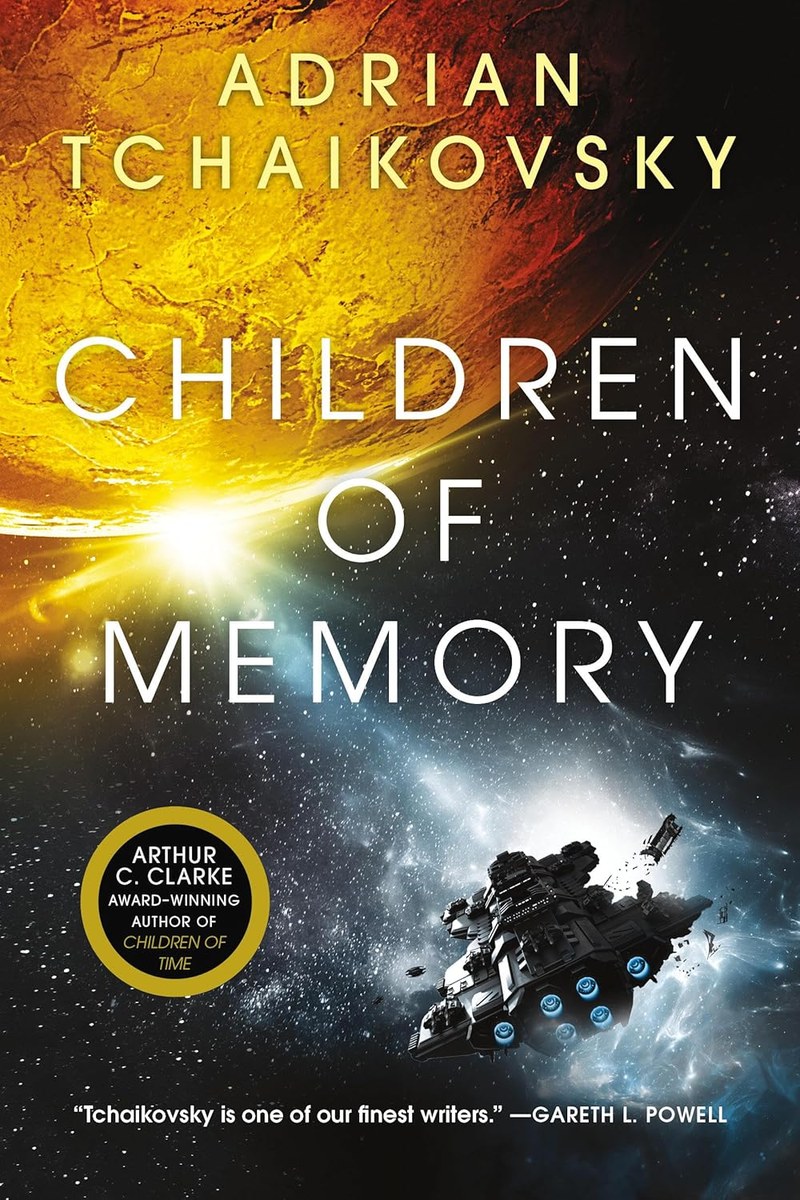
Children of Memory did not stick the landing. It’s a fine enough book, but an unsatisfactory conclusion to the series.
There’s a new species to introduce to pangalactic society: another terraforming expedition left behind an intelligent species of corvids. Corvids only work in bonded pairs, one novelty-seeking and one pattern-making, and while adept at data analysis, engineering work, and an apt quotation, insist they’re not sentient and neither is anyone else. The corvids are left behind, except for an exploratory pair, as the ship Skipper takes off to another planet that holds the remnants of a generation ship escaping from the dying Earth.
The crew (two spiders, one octopus, Avrana Kern, and a Nodian based on Miranda) infiltrates the small settlement in humanoid form and finds that something is deeply wrong. On the surface, the slapdash ecology is on the brink of collapse and famine, and the social structure is breaking down in suspicion of outsiders and militia backed factions. But the history of the colony, especially as experienced by 12-year-old Liff, descendant of the ship’s captain, doesn’t add up. There are gaps, skips, edits, repeated themes, people both present and absent, and a Witch in the hills.
The weirdness is resolved with the conclusion that it was all a dream. Sorry, it’s all a simulation running on some kind of alien computer buried beneath the planet’s crust. There never was a remnant colony, the ship’s shuttle spun in on impact, and everything since, including the radio signals that brought in the Skipper, just were clever illusions. Of course, identity is perhaps another illusion, one of memory, and why should we privilege identity running on neurons, but in a series at its best around the kinds of societies alternative minds create, Children of Memory offers very little.